
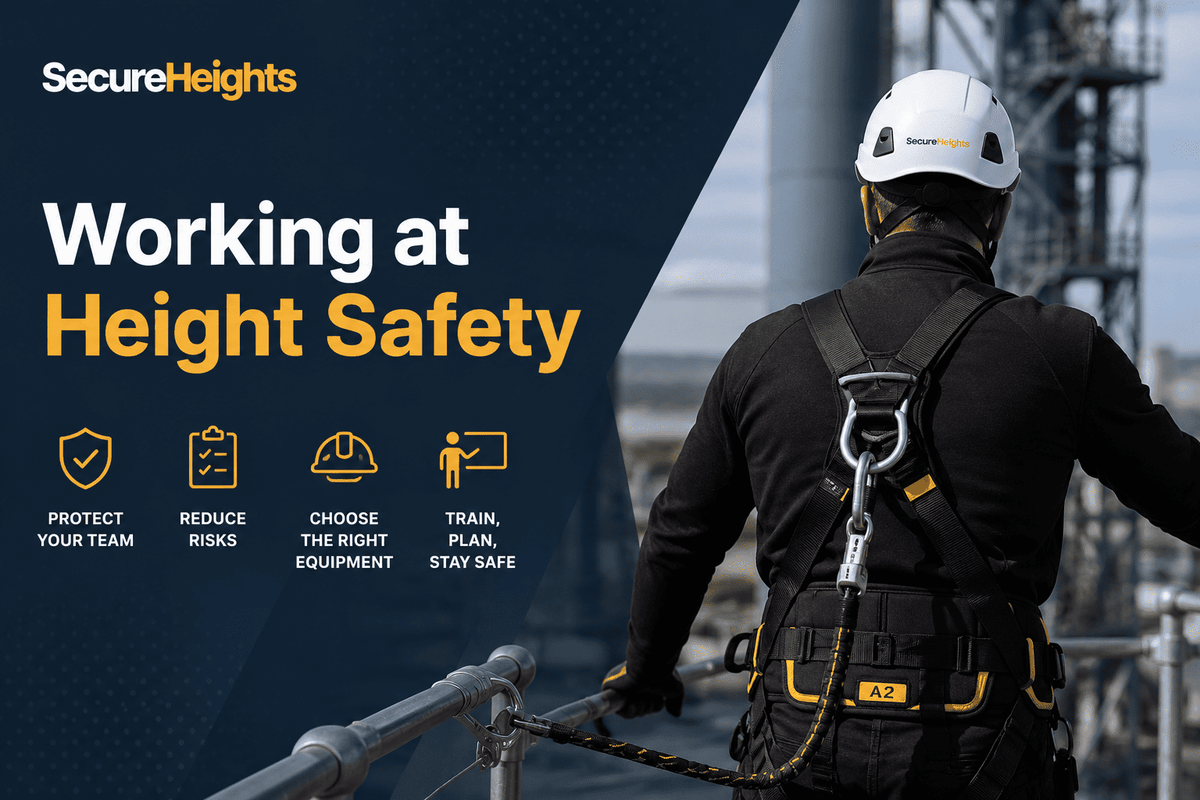
Key Points:
-
Working at height includes any task where a fall could result in injury, regardless of the height involved.
-
Effective height safety relies on risk assessments, proper planning, suitable equipment, and competent workers.
-
Fall protection systems may include restraint, arrest, work positioning, and anchorage solutions depending on the application.
-
Regular inspections, rescue planning, and ongoing training are essential for maintaining safe and compliant working at height operations.
Working at height remains one of the leading causes of serious workplace injuries and fatalities across the UK. Whether the task involves accessing a roof, using a ladder, working from scaffolding, or operating elevated platforms, the risk of a fall must always be carefully managed. Even falls from relatively low heights can result in serious injuries, making effective planning and control measures essential for any work activity carried out above ground level.
Understanding the principles of working at height safety is the first step towards creating a safer working environment. This guide explains the key legal requirements, common hazards, risk control measures, equipment types, and safe working practices that every employer, supervisor, and worker should be familiar with. Whether you are new to working at height or looking to strengthen your knowledge, this article provides a practical introduction to the fundamentals of height safety.
What Is Working at Height?
Working at height refers to any work activity where a person could fall and suffer an injury if suitable precautions were not in place. Under the Work at Height Regulations 2005, the focus is on the risk of injury from a fall rather than a specific height measurement. As a result, many routine tasks may be classified as work at height even when they take place relatively close to ground level.
Common examples of work at height include:
-
Using ladders and step ladders
-
Working from scaffolding or access towers
-
Roof inspection, maintenance, and repair
-
Operating mobile elevating work platforms (MEWPs)
-
Accessing elevated platforms and walkways
-
Working near roof edges, openings, or fragile surfaces
A common misconception is that fall protection is only required above a certain height. In reality, there is no minimum height specified in UK legislation. Any task that presents a risk of injury from a fall should be properly assessed and controlled using appropriate safety measures.
Why Working at Height Safety Is Important
Falls from height continue to be one of the leading causes of workplace fatalities and serious injuries in the UK. Every year, incidents involving roofs, ladders, scaffolding, platforms, and other elevated work areas result in significant harm to workers across multiple industries. Despite advances in equipment and safety procedures, falls remain a major challenge because many incidents occur during routine tasks that may appear low risk.
Several factors commonly contribute to fall-related accidents. In many cases, incidents are linked to inadequate planning, improper equipment selection, poor supervision, damaged equipment, unsafe access arrangements, or a lack of worker training. Environmental conditions such as rain, wind, and poor visibility can also increase risk.
|
Common Cause |
Potential Consequence |
|
Inadequate risk assessment |
Unidentified hazards and unsafe working conditions |
|
Incorrect equipment use |
Falls and equipment failure |
|
Lack of training |
Unsafe working practices |
|
Poor equipment maintenance |
Increased likelihood of accidents |
|
Fragile surfaces or roof openings |
Serious injuries from falls |
|
Adverse weather conditions |
Reduced stability and visibility |
The impact of a fall extends far beyond the immediate injury. Workers may face long recovery periods, while employers can experience project delays, increased costs, lost productivity, and potential legal action. The good news is that most fall-related incidents are preventable when work is properly planned, suitable control measures are implemented, and workers have access to the right training and equipment.
Understanding the Work at Height Regulations 2005
The Work at Height Regulations 2005 form the foundation of UK legislation governing activities where there is a risk of falling. The regulations apply to employers, self-employed individuals, contractors, facility managers, and anyone responsible for planning or controlling work at height. They are relevant across a wide range of sectors and apply regardless of whether the task is routine, temporary, or carried out for a short duration.
Employers have a legal duty to ensure work at height is properly planned, appropriately supervised, and carried out by competent people. This includes selecting suitable equipment, implementing effective control measures, maintaining equipment in safe condition, and ensuring workers receive adequate information, instruction, and training. Employers must also consider emergency arrangements and rescue procedures where a fall could occur.
Employees also have responsibilities under the regulations. Workers must follow safety procedures, use equipment correctly, participate in required training, and report hazards, defects, or unsafe conditions that may affect safety. Compliance depends on cooperation between employers and workers to ensure risks are managed effectively.
The Health and Safety Executive (HSE) is responsible for enforcing the regulations. Where serious breaches are identified, enforcement action may include improvement notices, prohibition notices that stop unsafe work activities, financial penalties, and, in severe cases, prosecution. Compliance with the regulations is not only a legal requirement but also an essential part of protecting workers and reducing the likelihood of preventable accidents.
The Hierarchy of Control for Working at Height
The hierarchy of control provides a clear framework for managing working at height risks. It prioritises the most effective measures before relying on personal protective equipment.
The first step is to avoid working at height wherever possible. If this cannot be achieved, measures should be introduced to prevent falls, such as guardrails, scaffolding, or protected work platforms.
Where a fall risk remains, controls should be used to minimise the consequences of a fall. Administrative measures such as risk assessments, supervision, and safe working procedures support these controls. Personal protective equipment, including harnesses and lanyards, should be used as the final layer of protection when other measures cannot fully eliminate the risk.
Collective Protection vs Personal Protection
Control measures used for working at height generally fall into two categories: collective protection and personal protection. Collective measures protect everyone within the work area and do not rely on individual actions, while personal protection depends on the user selecting, wearing, and using equipment correctly.
|
Collective Protection |
Personal Protection |
|
Guardrails |
Safety harnesses |
|
Edge protection systems |
Lanyards |
|
Scaffolding |
Lifelines |
|
Safety barriers |
Anchor devices |
|
Protects multiple workers |
Protects individual users |
|
Does not rely on user behaviour |
Requires correct use and training |
Collective protection is generally preferred because it provides a higher level of control over fall risks. Examples include guardrails installed around roof edges, scaffolding systems, temporary edge protection, and barriers used to restrict access to hazardous areas.
Personal protection measures are typically used when collective protection is not practical or cannot fully eliminate the risk. These systems may include harnesses connected to lanyards, lifelines, or suitable anchor points that help prevent falls or reduce the consequences should a fall occur.

Common Working at Height Hazards
Working at height presents a variety of hazards that can lead to serious incidents if not properly controlled. Unprotected edges remain one of the most common risks, particularly on roofs, platforms, and elevated structures. Fragile surfaces, including ageing roof sheets and rooflights, may not support a person's weight and can fail without warning.
Other hazards include roof openings, skylights, slips and trips caused by poor housekeeping, and adverse weather conditions such as rain, ice, or strong winds. Falling tools and materials also pose a significant risk to workers and members of the public below, making suitable exclusion zones and tool securing methods essential.
Types of Work at Height
Working at height covers a wide range of activities and access methods. Roof work often involves maintenance, inspection, installation, and repair tasks on flat or pitched roofs. Ladder work is commonly used for short-duration activities, while scaffolding and tower systems provide temporary access for larger projects.
Mobile Elevating Work Platforms (MEWPs), such as boom lifts and scissor lifts, allow workers to access elevated areas safely when used correctly. More specialised activities may involve rope access techniques or confined space entry where workers must operate both at height and within restricted environments. Each type of work presents different hazards and may require specific equipment, training, and safety procedures.
Working at Height Risk Assessments
A risk assessment helps identify hazards before work begins and ensures suitable precautions are implemented. The assessment should consider the work location, access requirements, environmental conditions, equipment selection, and the people who may be affected by the activity.
Once hazards have been identified, risks should be evaluated and appropriate control measures selected. Assessments should be reviewed whenever conditions change or new risks are introduced. In many workplaces, risk assessments are supported by Risk Assessment and Method Statements (RAMS) and permit-to-work systems, which help ensure tasks are carried out in a controlled and consistent manner.
Essential Working at Height Equipment
A wide range of equipment is used to support safe work at height. Access equipment such as ladders, step ladders, mobile towers, scaffolding, and Mobile Elevating Work Platforms (MEWPs) helps workers reach elevated areas safely when selected and used correctly.
Personal fall protection equipment may include safety harnesses, lanyards, energy absorbers, self-retracting lifelines (SRLs), and anchor devices. Additional PPE such as safety helmets with chin straps, protective footwear, gloves, and high-visibility clothing may also be required depending on the work environment and site requirements.
|
Equipment Type |
Primary Purpose |
|
Ladders and step ladders |
Short-duration access |
|
Mobile towers and scaffolds |
Temporary elevated work platforms |
|
MEWPs |
Powered access to elevated areas |
|
Safety harnesses |
User attachment and support |
|
Lanyards and energy absorbers |
Connection and fall force reduction |
|
Self-retracting lifelines |
Continuous fall protection |
|
Anchor devices |
Secure attachment points |
|
Helmets and PPE |
Additional worker protection |
Understanding Fall Protection Systems
Different fall protection systems are designed to achieve different safety objectives. Fall restraint systems prevent users from reaching a location where a fall could occur, while fall arrest systems are designed to stop a fall safely if one takes place.
Work positioning systems allow users to work with both hands free while remaining supported in position. Rope access systems combine access and fall protection techniques for specialised applications, while safety net systems provide collective protection beneath elevated work areas where appropriate.
How to Select the Right Fall Protection Equipment
Selecting suitable fall protection equipment requires consideration of the specific task and working environment. Factors such as the type of work being performed, available fall clearance, anchor point suitability, and environmental conditions can all influence equipment selection.
User competence is equally important, as workers must understand how to inspect, fit, and use equipment correctly. All components should be compatible and designed to function together as a complete system. Choosing equipment based on risk assessment findings helps ensure both safety and compliance while supporting efficient working practices.
SecureHeights Insight: Selecting fall protection equipment should never be based solely on product specifications or cost. In our experience, the most effective solutions are those chosen as part of a complete system that considers the work environment, user requirements, anchor arrangements, and rescue planning. A properly designed system can significantly improve both safety and operational efficiency.
Recommended Safety Harnesses for Working at Height
A safety harness is one of the most important components of a personal fall protection system. It provides a secure connection between the user and the fall protection equipment, helping to support fall arrest, fall restraint, work positioning, and rescue activities. Selecting the right harness depends on the specific task, working environment, and operational requirements.
3M Protecta E200 Standard Vest Style Fall Arrest Harness with Rear Attachment Point

(The 3M Protecta E200 Standard Vest Style Fall Arrest Harness is a practical entry-level solution designed for workers who require reliable fall protection during routine work at height activities. Featuring a rear D-ring attachment point for fall arrest applications, this harness offers a simple vest-style design that is easy to fit and adjust. The water and stain resistant webbing helps maintain durability in demanding environments, while protected identification labels support long-term traceability and inspection management. Suitable for industries including construction, manufacturing, transportation, mining, and general industrial applications, the E200 provides a straightforward and dependable option for users seeking effective fall protection without unnecessary complexity).
Petzl VOLT Fall Arrest and Work Positioning Harness European Version

(The Petzl VOLT is a versatile harness designed for both fall arrest and work positioning applications, making it suitable for a wide range of professional work at height tasks. Its ergonomic design combines wide, semi-rigid leg loops and waist support with breathable materials to enhance comfort during extended use. The harness features multiple attachment points for fall arrest, positioning, restraint, and vertical progression systems, while the integrated LADDER CLIMB attachment point helps improve comfort when using rail or cable-based fall protection systems. With automatic FAST buckles for quick fitting and numerous options for organising tools and accessories, the VOLT is a popular choice for workers who require a high level of functionality, mobility, and all-day comfort in demanding environments).
Climbing Technology WORK TEC Fall Restraint Harness

(The Climbing Technology WORK TEC is a lightweight and ergonomic harness designed primarily for fall restraint applications and work activities carried out on horizontal surfaces or inclined areas up to 30°. Featuring both chest and rear attachment points, it can be incorporated into systems that help prevent workers from reaching locations where a fall could occur. Adjustable padded shoulder straps, a breathable lumbar support section, and self-locking leg loop buckles contribute to user comfort during extended periods of wear. Its practical design also includes tool-carrying loops and a secure chest closure system, making it a straightforward and comfortable solution for routine work at height tasks where fall restraint is the preferred control measure).
P+P Safety Quick Fit FRS Rescue Fall Arrest Harness 90288MK2

(The P+P Safety Quick Fit FRS Rescue Fall Arrest Harness is designed for applications where both fall protection and rescue capability may be required. The harness features front and rear fall arrest attachment points alongside an additional overhead rescue attachment point, making it suitable for emergency recovery situations and rescue planning procedures. Adjustable shoulder and leg straps help achieve a secure fit, while the full chest strap configuration improves load distribution when the front attachment point is used. Constructed from durable polyester webbing with corrosion-resistant metal fittings, this harness provides a practical solution for workers operating in environments where rescue readiness forms an important part of the overall safety strategy).
3M Protecta Fall Protection Roofers Kit 1150511

(The 3M Protecta Fall Protection Roofers Kit is a complete fall protection kit designed for workers involved in roofing, inspection, maintenance, and other roof access activities. The kit includes a 3M Protecta Standard Vest Style Fall Arrest Harness, a Viper LT rope grab system with integrated energy absorber and 10 m rope, a 1 m anchorage sling, and a storage rucksack, providing users with a convenient ready-to-use fall protection solution. Designed to simplify equipment selection and ensure compatibility between components, this kit is particularly well suited to organisations seeking a practical entry point into roof safety and personal fall protection systems).
Whether you require a basic fall arrest harness for occasional work at height or a more advanced solution for positioning, rescue, or specialist applications, choosing equipment that is suitable for the intended task is essential. SecureHeights supplies a wide range of safety harnesses from leading manufacturers, helping organisations select solutions that support both safety and compliance.
Anchor Points and Anchorage Systems
Anchor points provide the connection between a worker and a fall protection system. Depending on the application, anchors may be temporary or permanent and must be suitable for the loads they may be required to withstand.
Common anchorage solutions include temporary anchor devices for short-term work, permanently installed anchors for ongoing access requirements, vertical lifeline systems that provide continuous protection during ascent and descent, horizontal lifeline systems that allow movement across larger areas, and rigid rail systems that provide continuous protection along a fixed path. On flat roofs where structural attachment is not practical, deadweight anchors may be used to provide a non-penetrative anchorage solution.
Safe Working Practices for Roof Access
Roof work presents unique hazards that vary depending on the roof type and condition. Flat roofs may create a false sense of security, while pitched roofs increase the likelihood of slips and loss of footing. Fragile roof materials and rooflights require particular attention because they may not support a person's weight.
Effective roof safety relies on suitable edge protection, safe access and egress arrangements, competent workers, and appropriate fall protection measures. Conditions should also be monitored throughout the task to ensure risks remain adequately controlled.
Preventing Dropped Objects
Dropped objects can cause serious injuries, property damage, and operational disruption. Even small tools or materials falling from height can create significant hazards for people working below.
Preventative measures often include tool tethering systems, secure storage solutions, and designated exclusion zones around work areas. Materials should be properly secured during transport and use, while tethering equipment should be regularly inspected for signs of wear, damage, or deterioration. A structured dropped object prevention strategy helps reduce risks to both workers and the surrounding environment.
Equipment Inspection and Maintenance
Regular inspection and maintenance are essential for ensuring working at height equipment remains safe and fit for use. Users should carry out pre-use checks before each task, while more detailed formal inspections should be completed by a competent person at appropriate intervals.
Inspection frequencies may vary depending on the equipment type, manufacturer guidance, usage conditions, and applicable regulations. Accurate inspection records should be maintained to demonstrate compliance and support equipment management. Any equipment showing signs of damage, excessive wear, deformation, corrosion, or other defects should be removed from service immediately until it has been assessed and approved for continued use.
Emergency Rescue Planning
A rescue plan should be established before work at height begins. Relying solely on emergency services is rarely considered sufficient, as a suspended worker may require assistance within a short period of time.
Rescue arrangements may include self-rescue procedures, assisted rescue by trained colleagues, or technical rescue methods for more complex situations. Appropriate rescue equipment should be available, accessible, and suitable for the specific work environment. Planning and regular practice help ensure a prompt and effective response if an incident occurs.
Training and Competence
Competence is a combination of knowledge, practical skills, training, and experience. Workers involved in activities at height should understand the hazards associated with their tasks and be capable of using equipment safely and correctly.
Training requirements will vary depending on the work being undertaken and the equipment being used. This may include general working at height awareness, PPE user training, equipment inspection training, and rescue training where relevant. Refresher training should also be considered to maintain competence, reinforce safe working practices, and address changes in equipment, procedures, or legislation.
Common Working at Height Mistakes
Many incidents occur not because suitable equipment is unavailable, but because basic safety principles are overlooked. Common mistakes include overreaching from ladders, selecting unsuitable anchor points, failing to inspect equipment before use, and continuing work during unsafe weather conditions.
Other frequent issues include inadequate supervision, a lack of rescue planning, and improper use of PPE. Even high-quality equipment may not provide effective protection if it is used incorrectly or outside its intended application. Preventing these mistakes requires a combination of planning, training, and ongoing safety awareness.
How Engineered Fall Protection Systems Improve Safety
In some environments, PPE alone may not provide sufficient protection. Large roofs, complex structures, frequent access requirements, and high-risk work areas often benefit from engineered fall protection systems designed specifically for the site and its operational needs.
Common engineered solutions include:
-
Permanent anchor systems
-
Horizontal lifeline systems
-
Vertical lifeline systems
-
Rigid rail systems
-
Roof access and walkway systems
-
Edge protection solutions
-
Integrated rescue and access systems
These systems help provide consistent protection while improving usability and efficiency. By creating clearly defined safe working areas and reducing reliance on temporary controls, engineered solutions can support compliance, simplify maintenance activities, and improve long-term safety performance across a site.
SecureHeights Insight: Many sites initially rely on temporary controls and PPE to manage fall risks. However, where regular access is required, engineered fall protection systems often provide a safer, more practical, and more sustainable long-term solution. At SecureHeights, we frequently support organisations in developing permanent safety systems that improve compliance while simplifying day-to-day operations.
Conclusion
Working at height safety relies on a combination of planning, risk assessment, suitable equipment, competent workers, and effective control measures. By understanding the hazards involved and applying the principles outlined in this guide, organisations can significantly reduce the likelihood of falls and create safer working environments for everyone involved.
Whether you require fall protection equipment, anchorage systems, confined space access solutions, or fully engineered fall protection systems, SecureHeights provides a comprehensive range of products and technical solutions to support safe work at height. Our team can help organisations select appropriate equipment and systems that align with their operational requirements while supporting compliance with current safety standards and best practices.

