
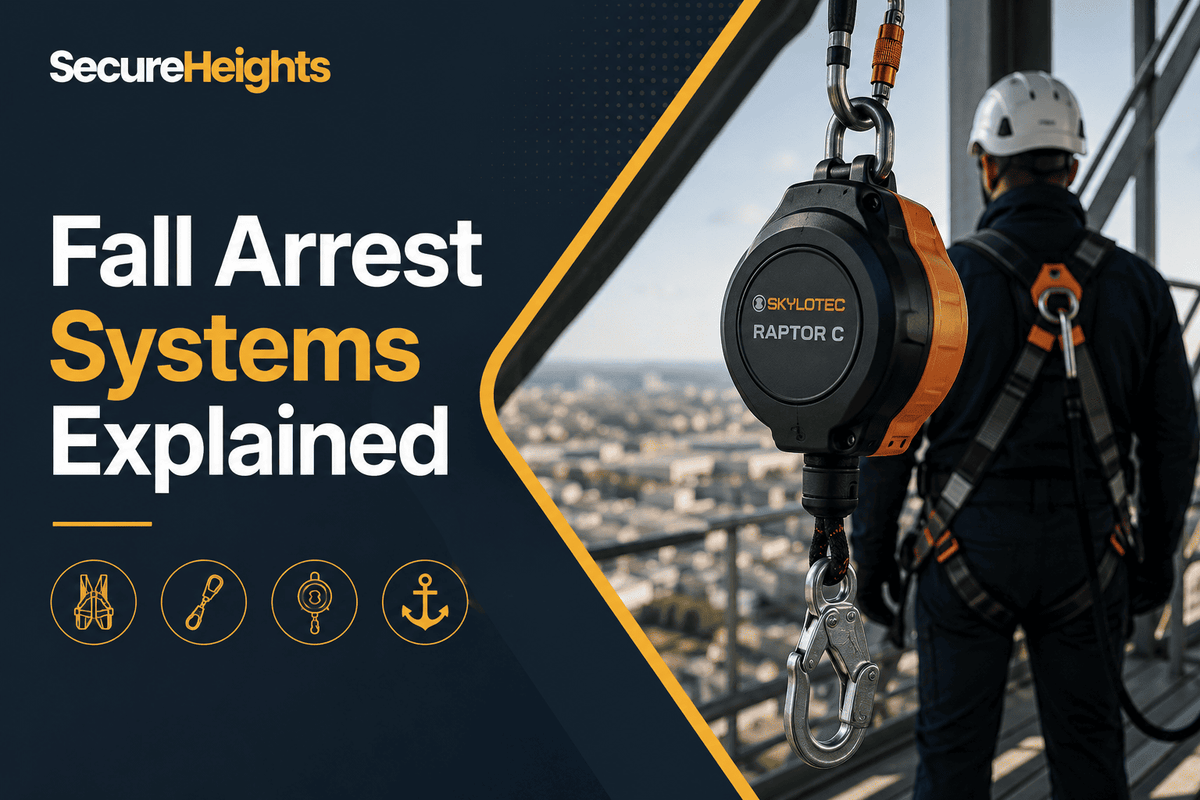
Key Points:
-
Fall arrest systems are designed to safely arrest a fall and reduce the risk of serious injury when exposure to fall hazards cannot be avoided.
-
Effective fall protection requires more than equipment alone, including proper system design, fall clearance calculations, inspections, training, and rescue planning.
-
Fall restraint and collective protection measures should be prioritised wherever possible, with fall arrest typically used as a last-resort solution.
-
Engineered fall arrest systems can provide site-specific protection for complex environments, helping organisations improve safety, compliance, and operational efficiency.
Falls from height remain one of the leading causes of serious injuries and fatalities across a wide range of industries, including construction, facilities management, utilities, manufacturing and infrastructure maintenance. Whenever work must be carried out above ground level, organisations have a responsibility to assess the risks involved and implement appropriate measures to protect workers. While collective protection methods such as guardrails and barriers should always be considered first, there are situations where personal fall protection systems become necessary to enable safe access to the work area.
A fall arrest system is designed to protect a worker after a fall has occurred by safely arresting the fall and reducing the risk of serious injury. These systems play a critical role when workers need access to locations where exposure to a fall hazard cannot be completely eliminated. Understanding how fall arrest systems work, when they should be used, and the factors that influence their design is essential for anyone responsible for managing work at height. This guide explains the key principles, components and considerations involved in selecting and using fall arrest systems safely and effectively.
What Is a Fall Arrest System?
A fall arrest system is a type of personal fall protection system designed to stop a worker safely after a fall has occurred. Rather than preventing access to a hazard, it allows the user to work in areas where exposure to a fall risk cannot be completely avoided while reducing the likelihood of serious injury.
A typical fall arrest system consists of several components working together:
-
A full body harness
-
A connecting device such as a lanyard or self-retracting lifeline
-
An energy absorber
-
A secure anchor point or anchorage system
-
Compatible connectors and attachment hardware
When a fall occurs, the system activates to arrest the user's movement, control the forces generated during the fall, and prevent contact with the ground, lower levels, or surrounding structures. For a fall arrest system to function effectively, all components must be properly selected, installed, inspected, and used in accordance with the manufacturer's requirements and relevant standards.
Why Fall Arrest Is Used as a Last Resort
Although fall arrest systems are highly effective when properly designed and used, they do not prevent a fall from occurring. The worker is still exposed to the physical forces generated during the fall and may be at risk of injury, even when the system performs as intended.
For this reason, industry guidance and regulations generally favour solutions that remove the hazard altogether or prevent workers from reaching it. Fall arrest should only be selected when other control measures are not reasonably practicable and the work cannot be completed safely using alternative methods.
Fall Protection Hierarchy: What Comes Before Fall Arrest?
The hierarchy of fall protection provides a structured approach to managing work at height risks. The objective is to select the safest control measure available before relying on personal protective equipment.
The typical hierarchy follows this order:
-
Avoid work at height where possible.
-
Eliminate fall hazards through design or alternative working methods.
-
Use collective protection such as guardrails, barriers, or edge protection.
-
Use fall restraint systems that prevent access to the hazard.
-
Use fall arrest systems where a fall cannot be prevented.
Following this hierarchy helps organisations reduce risk at its source rather than relying solely on equipment to minimise the consequences of a fall.
Fall Arrest vs Fall Restraint: What Is the Difference?
Fall arrest and fall restraint systems may use similar equipment, but they serve different purposes. A fall restraint system prevents a worker from reaching an area where a fall could occur, while a fall arrest system allows access to the hazard and provides protection if a fall happens.
The key distinction is that fall restraint eliminates the possibility of falling under normal use, whereas fall arrest manages the consequences after a fall has occurred. Because of this, fall restraint is generally considered the safer option whenever site conditions allow it.
In practice, the choice between the two depends on factors such as the work activity, available fall clearance, access requirements, and the physical layout of the site. A suitable risk assessment should always determine which approach is most appropriate for the task.
Active Fall Protection Systems Explained
Active fall protection systems are solutions that require the user to take specific actions in order to remain protected. This typically involves connecting to an anchor point, lifeline, rail system, or other approved anchorage device before beginning work.
Fall arrest and fall restraint systems are both classified as active protection because their effectiveness depends on correct use by the worker. If the equipment is not connected properly or is used incorrectly, the level of protection may be compromised. For this reason, active systems rely heavily on user training, competence, equipment inspections, and safe working procedures.
Collective Fall Protection vs Personal Fall Arrest
Collective fall protection systems are designed to protect multiple workers at the same time without requiring them to wear or operate individual safety equipment. Examples include guardrails, edge protection systems, safety barriers, and safety nets. Because protection is built into the work environment, these solutions generally provide the highest level of safety.
Personal fall arrest systems, by comparison, protect individual users through the use of harnesses, lanyards, lifelines, and anchor points. They are often selected where collective protection is not practical due to structural constraints, operational requirements, access limitations, or project costs.
While personal fall arrest systems offer greater flexibility and access to difficult work areas, they require ongoing inspection, user training, equipment management, and rescue planning. As a result, collective protection measures are usually preferred whenever they can reasonably be implemented.
Main Components of a Fall Arrest System
A fall arrest system relies on several components working together to provide effective protection. Each element performs a specific function, and the overall performance of the system depends on the compatibility and correct selection of every component.
|
Component |
Purpose |
|
Full Body Harnesses |
Secure the user and distribute arrest forces across stronger areas of the body, helping to reduce the risk of injury during a fall. |
|
Lanyards and Shock Absorbers |
Connect the user to the anchorage system while helping to limit the forces generated during fall arrest. |
|
Self-Retracting Lifelines (SRLs) |
Extend and retract automatically as the user moves, locking quickly when sudden acceleration is detected. |
|
Rope Grabs and Guided Fall Arresters |
Travel along a flexible or rigid line and automatically engage if a fall occurs. |
|
Anchor Points and Anchorage Systems |
Provide the structural attachment required to support fall arrest loads and maintain system integrity. |
|
Horizontal Lifelines |
Allow users to move laterally across a work area while remaining connected to a continuous safety system. |
|
Vertical Lifelines |
Provide protection during climbing and descending activities on ladders, towers, and similar structures. |
|
Connectors and Attachment Devices |
Include carabiners, hooks and specialised connectors used to link system components together safely. |
Although individual components may appear simple, they must always be selected as part of a complete fall protection solution. Factors such as working environment, user movement, fall clearance, structural capacity, and rescue requirements can all influence which equipment is most suitable for a particular application.
Types of Fall Arrest Systems
Different fall arrest systems are designed to suit different working environments, access requirements, and structural conditions. The most appropriate solution depends on factors such as user movement, work frequency, available anchorage, and the nature of the fall hazard.
Single Anchor Point Systems
Single anchor point systems use an individual certified anchor that allows one worker to connect directly to a fixed attachment location. These systems are commonly used for inspection, maintenance, and short-duration tasks where movement is limited to a relatively small work area.
Horizontal Lifeline Systems
Horizontal lifeline systems enable users to travel across larger areas while remaining continuously connected. They are widely installed on rooftops, industrial facilities, loading areas, and other locations where workers need unrestricted movement along a defined route.
Vertical Lifeline Systems
Vertical lifeline systems are designed for climbing applications and are commonly installed on ladders, towers, masts, and access structures. They allow users to move vertically while maintaining continuous protection throughout ascent and descent.
Rigid Rail Fall Arrest Systems
Rigid rail systems use a fixed track rather than a flexible cable. They are often selected for environments where precise movement, reduced system deflection, and enhanced user support are required. These systems are frequently found in industrial facilities, maintenance platforms, and specialist access installations.
Temporary Fall Arrest Systems
Temporary systems are intended for short-term projects, shutdowns, construction activities, or maintenance work. They can often be installed and removed with minimal impact on the structure, making them suitable where permanent systems are not required.
Safety Nets and Airbags
Safety nets and inflatable airbags provide collective fall arrest protection by reducing the consequences of a fall before contact with a lower level occurs. They are commonly used in construction environments where installing personal attachment systems may not be practical during certain phases of work.
Mobile Fall Arrest Solutions
Mobile fall arrest solutions are designed to be moved between locations as operational requirements change. Examples include portable anchor devices, mobile deadweight systems, and transportable fall protection equipment used across multiple work sites or temporary work areas.
Fall Arrest Blocks and Self Retracting Lifelines
Self retracting lifelines (SRLs), often referred to as fall arrest blocks, are among the most commonly used devices within modern fall arrest systems. Designed to extend and retract automatically as the user moves, they help minimise slack in the system while providing rapid fall arrest when required. Available in a wide range of lengths, materials, and configurations, SRLs can be used across numerous work at height applications, from rooftop maintenance and construction projects to industrial access and confined space operations.
CAMP Safety COBRA 30m Self Retracting Fall Arrest Block 3140

(The CAMP Safety COBRA 30m Self Retracting Fall Arrest Block is a heavy-duty self-retracting lifeline designed for demanding work at height applications that require an extended working range. Equipped with a 30-metre galvanised steel cable housed within a durable ABS casing, it provides reliable fall arrest protection while allowing smooth user movement over significant vertical distances. The device incorporates an internal mechanical energy absorption system and is supplied with an auto-locking swivel connector to help reduce cable twisting during use. It is also certified for horizontal and inclined applications when used with the appropriate external energy absorber, making it suitable for construction, industrial maintenance, infrastructure projects, and other environments where versatile long-range fall protection is required).
3M DBI SALA Sealed-Blok 40m Stainless Steel Cable Self Retracting Lifeline with Rescue Winch 3400986

(The 3M DBI SALA Sealed-Blok 40m Stainless Steel Cable Self Retracting Lifeline with Rescue Winch is a heavy-duty self-retracting lifeline designed for demanding work at height and confined space applications where both fall protection and assisted rescue capabilities are required. Featuring a 40-metre stainless steel cable, corrosion-resistant aluminium housing, and sealed internal components with an IP69K-rated design, it is engineered to perform reliably in harsh environments such as offshore facilities, oil and gas installations, mining operations, utilities, wastewater treatment plants, and other highly contaminated or wet locations. The integrated three-way rescue winch allows controlled retrieval or lowering of a suspended worker, while the speed-sensing braking system rapidly arrests a fall and helps limit arrest forces. Its durable construction, pivoting anchorage loop, and stainless steel components make it a practical solution for long-term use in some of the most challenging industrial environments).
3M Protecta Rebel Leading Edge 6m Galvanised Steel Cable Self Retracting Lifeline 3590542

(The 3M Protecta Rebel Leading Edge 6m Galvanised Steel Cable Self Retracting Lifeline is designed for work at height applications where there is a risk of the lifeline coming into contact with edges during a fall. Featuring a 6-metre galvanised steel cable housed within a durable plastic casing, this leading edge SRL helps provide effective fall arrest protection while allowing users to move freely within the work area. Its compact design makes it suitable for a variety of construction, maintenance, and industrial tasks where edge-related hazards are present, making it a practical solution for environments that require enhanced fall protection capabilities).
3M DBI SALA Nano-Lok 1.8m Single Leg Web Self Retracting Lifeline 3101709

(The 3M DBI SALA Nano-Lok 1.8m Single Leg Web Self Retracting Lifeline is a compact personal SRL designed to provide effective fall protection while maintaining a high level of user mobility. Its lightweight construction and low-profile design make it a practical alternative to traditional lanyards, helping to reduce snagging and improve comfort during daily work at height activities. The smart-activating braking system delivers reduced fall clearance requirements compared with many conventional lanyard systems, making it particularly suitable for applications where available clearance is limited. Commonly used in construction, utilities, transportation, and industrial environments, the Nano-Lok combines ease of use, durability, and reliable fall arrest performance in a highly portable solution).
Skylotec PEANUT I 1.8m Self Retracting Lifeline with 60mm FS 90 ALU Scaffold Hook HSG-021-1,8-1

(The Skylotec PEANUT I 1.8m Self Retracting Lifeline is a compact and versatile fall arrest device designed for applications where mobility and low fall clearance are important considerations. Its self-retracting webbing helps minimise slack and reduce potential fall distances, while the integrated 60mm scaffold hook provides compatibility with a wide range of structural attachment points. Approved for edge use and suitable for both vertical and horizontal applications, the PEANUT I is commonly used on mobile elevating work platforms, masts, towers, roofs, and facades. The device also incorporates a visual fall indicator and is designed to accommodate a broad range of user weights, making it a practical solution for diverse work at height environments).
Selecting the right self retracting lifeline depends on factors such as working environment, available fall clearance, anchorage arrangement, user mobility requirements, and rescue considerations. Whether you require a compact webbing SRL for general maintenance tasks or a specialist retrieval unit for more demanding applications, choosing equipment that aligns with your overall fall protection strategy is essential for supporting both safety and operational efficiency.
Where Fall Arrest Systems Are Commonly Used
Fall arrest systems are used in environments where workers must operate at height and exposure to a fall hazard cannot be fully eliminated through collective protection or restraint measures. They are particularly valuable in locations that require regular inspection, maintenance, installation, or repair activities.
Common applications include:
-
Commercial and industrial rooftops
-
Construction and refurbishment projects
-
Manufacturing facilities
-
Warehouses and distribution centres
-
Energy and utility infrastructure
-
Telecommunications towers and masts
-
Transportation facilities and depots
-
Water treatment and processing plants
-
Confined space access locations
-
Bridges and other civil engineering structures
The level of protection required can vary significantly between sites. Some environments may only require simple anchor points for occasional access, while others may need complex engineered systems that support multiple users across large working areas. Selecting the appropriate solution depends on the specific hazards, access requirements, and operational activities present at the location.
Examples of Fall Arrest Applications
Fall arrest systems are used across a wide range of industries where workers must access elevated or hazardous locations. While the specific equipment may vary, the objective remains the same: protecting users when exposure to a fall hazard cannot be completely avoided.
Some common applications include:
-
Rooftop Maintenance - inspecting, servicing, and repairing plant equipment, HVAC systems, solar panels, drainage systems, and roof-mounted installations.
-
Construction and Scaffolding - carrying out structural work, façade installation, roofing activities, steel erection, and temporary access operations.
-
Industrial Facilities - accessing machinery, production equipment, loading areas, maintenance platforms, and elevated workstations.
-
Power, Utilities and Telecoms - working on transmission structures, substations, communication towers, utility poles, and network infrastructure.
-
Confined Space and Rescue Access - entering shafts, tanks, chambers, manholes, and other restricted spaces where controlled access and retrieval capabilities are required.
-
Offshore and High-Risk Environments - operating on offshore platforms, marine facilities, energy installations, and remote structures where challenging conditions increase the complexity of work at height.
Each application presents different risks, environmental conditions, and access requirements. As a result, fall arrest systems should be selected and designed to match the specific operational demands of the location rather than relying on a one-size-fits-all approach.
How a Fall Arrest System Works During a Fall
When a fall occurs, the system is designed to arrest the user's movement in a controlled manner rather than stopping it instantly. As the worker falls, the connecting device activates and the energy absorption elements help reduce the forces transmitted to the body and anchorage structure.
The process generally follows four stages:
-
The fall begins.
-
The arrest device engages.
-
Energy is absorbed and deceleration occurs.
-
The worker remains suspended until rescue can be carried out.
The effectiveness of this process depends on proper equipment selection, correct installation, adequate clearance, and a suitable rescue plan.
Fall Clearance Explained
Fall clearance is the minimum unobstructed distance required below a worker to ensure that, if a fall occurs, the user does not strike the ground, equipment, structures, or other obstacles before the system fully arrests the fall.
Insufficient clearance is one of the most serious risks associated with personal fall arrest systems. Even when all equipment functions correctly, a lack of available clearance can result in severe injury because the worker may contact a lower level before the system completes the arrest process.
Required clearance varies depending on the type of equipment used, the location of the anchor point, the user's position, and the characteristics of the fall arrest device.
How to Calculate Fall Distance
Calculating fall distance is an essential part of system design and risk assessment. The total distance travelled during a fall is influenced by several factors, including the equipment configuration and the worker's position relative to the anchorage.
Typical considerations include:
-
Free fall distance before the system engages
-
Deceleration distance during energy absorption
-
Harness stretch and system movement
-
Height of the worker
-
Additional safety allowance
Manufacturers normally provide specific performance data for their equipment, which should always be used when calculating fall clearance. Because every application is different, fall distance calculations should be verified before work begins to ensure sufficient clearance is available throughout the work area.
Free Fall Distance, Deceleration Distance and Safety Margin
Several factors contribute to the total distance travelled during a fall. Understanding these elements is essential when selecting equipment and determining whether sufficient clearance exists below the work area.
-
Free fall distance refers to the distance travelled before the fall arrest system begins to engage.
-
Deceleration distance is the additional distance required for energy absorbers or other arrest devices to slow and stop the fall safely.
-
Safety margin provides extra clearance to account for movement, measurement tolerances, and unexpected variables.
These values vary depending on the type of equipment being used and should always be verified using manufacturer guidance and site-specific calculations.
The Pendulum Effect and Swing Fall Hazards
A swing fall can occur when the worker is positioned horizontally away from the anchor point. Instead of falling directly below the anchorage, the individual may swing in an arc similar to a pendulum.
This movement can create additional hazards, including:
-
Impact with nearby structures or equipment
-
Contact with building edges
-
Increased forces on the body and equipment
-
Difficulty during rescue operations
To reduce swing fall risks, anchor points should be positioned as close as reasonably possible above the work area, and worker movement should be managed within the limits specified by the system design.
Fall Arrest System Requirements
A fall arrest system must be suitable for the specific work activity, environment, and level of risk present at the site. Simply selecting compliant equipment is not enough. The entire system must function as an integrated solution.
Key requirements typically include:
-
Adequate structural support for all applied loads
-
Compatible and correctly certified components
-
Sufficient fall clearance
-
Appropriate user training and competency
-
Regular inspection and maintenance
-
A documented rescue plan
-
Compliance with applicable regulations and standards
Before implementation, the system should be assessed to ensure it can provide effective protection throughout the intended work area while supporting safe access and operational requirements.

Design Considerations for Engineered Fall Arrest Systems
Engineered fall arrest systems are designed around the specific conditions of a site rather than relying on standard equipment alone. The design process typically considers how workers access the area, where fall hazards are located, how many users require protection, and how the system will be used over time.
Important factors include worker movement patterns, maintenance requirements, environmental conditions, rescue arrangements, and future operational changes. A well-designed system should not only provide protection during a fall but also support efficient and practical day-to-day use.
Structural Load Requirements and Anchor Positioning
The structure supporting a fall arrest system must be capable of withstanding the loads generated during a fall event. This requires an assessment of the supporting building elements, roof construction, steelwork, concrete structure, or other load-bearing components before installation takes place.
Anchor positioning is equally important. Poorly located anchors can restrict movement, increase swing fall risks, or create unnecessary challenges for users. Effective anchor placement should provide suitable coverage of the work area while maintaining safe load paths and minimising exposure to hazards.
Safe Access Routes, Walkways and Fragile Roof Areas
Fall protection should not focus solely on the location where work is performed. Safe access to and from the work area is equally important. Workers often face risks while travelling across rooftops, plant areas, elevated structures, or maintenance zones before reaching their destination.
Dedicated walkways and clearly defined access routes can help guide users through safer areas while reducing the likelihood of slips, trips, and unintended exposure to fall hazards. Additional controls may also be required around fragile roof materials, rooflights, skylights, and other surfaces that are not designed to support pedestrian loads.
By combining access management with fall protection measures, organisations can create a more comprehensive approach to work at height safety across the entire site.
Protecting Roof Hatches, Skylights and Openings
Roof hatches, skylights, rooflights, and other openings can present significant fall hazards, particularly during maintenance activities. Many rooflight materials are not designed to support the weight of a person and may appear safe to walk on despite being fragile.
Protection measures may include guardrails, covers, safety screens, demarcation systems, or dedicated fall protection solutions positioned around the hazard. The most appropriate method depends on the design of the roof, frequency of access, and operational requirements of the site.
Regular inspection of these areas is important, as ageing materials and environmental exposure can affect their condition over time.
Permanent vs Temporary Fall Arrest Solutions
Permanent fall arrest systems are installed as part of the building or structure and remain available for ongoing use. They are commonly selected for locations that require routine inspection, maintenance, or operational access throughout the year.
Temporary systems are generally used for short-term projects, construction activities, shutdowns, or occasional maintenance work. These solutions can provide flexibility where permanent installation is not practical or economically justified.
The choice between permanent and temporary protection depends on factors such as frequency of access, expected service life, installation requirements, user numbers, and long-term operational needs.
Cost Considerations: Upfront Cost vs Long-Term Compliance
The initial purchase and installation cost of a fall arrest system represents only part of the overall investment. Organisations should also consider the ongoing requirements associated with ownership and compliance.
Long-term costs may include:
-
Periodic inspections and recertification
-
Equipment replacement
-
Maintenance and repairs
-
User training
-
Rescue equipment and preparedness
-
System upgrades as site requirements change
While some solutions may appear less expensive at the point of purchase, a full lifecycle assessment often provides a more accurate understanding of overall value. Selecting a system that balances safety, usability, durability, and compliance requirements can help reduce operational costs over the long term.
UK Regulations and Relevant Standards
Several regulations and standards influence how fall arrest systems are designed, installed, inspected, and used within the UK. Understanding the purpose of each document helps organisations maintain compliance and support safe working practices.
|
Regulation / Standard |
Purpose |
|
Work at Height Regulations 2005 |
The primary UK legislation governing work at height. It requires risks to be assessed, work to be properly planned, and suitable fall protection measures to be implemented. |
|
EN 363 |
Defines personal fall protection systems and explains how individual components function together as a complete system. |
|
EN 365 |
Establishes requirements for equipment marking, user instructions, inspection procedures, maintenance, and periodic examination. |
|
EN 795 |
Specifies performance and testing requirements for anchor devices used within personal fall protection systems. |
|
BS 7883 |
Provides guidance on the design, installation, use, inspection, and maintenance of anchor systems for personal fall protection. |
|
BS 8437 |
Offers recommendations for selecting, using, inspecting, and managing personal fall protection equipment, including rescue planning considerations. |
While compliance requirements may vary depending on the application and type of system installed, these documents form the foundation of good practice for fall arrest system design, operation, and ongoing management.
Training and Competency Requirements
The effectiveness of a fall arrest system depends not only on the equipment itself but also on the competence of the people using it. Workers should understand the limitations of the system, know how to connect correctly, recognise potential hazards, and follow established safety procedures.
Training requirements may vary depending on the complexity of the work and the equipment being used, but commonly include:
-
Hazard identification and risk awareness
-
Correct use of fall protection equipment
-
Pre-use inspection procedures
-
Safe access and movement techniques
-
Emergency and rescue procedures
-
Understanding site-specific safety requirements
Refresher training and periodic competency assessments can help ensure that knowledge remains current and that safe working practices are maintained over time.
User Health, Weather and Site Conditions
Work at height often takes place in environments where external factors can influence safety. Before work begins, consideration should be given to both the condition of the worksite and the capability of the individuals carrying out the task.
Factors that may affect safe system use include:
-
Strong winds
-
Rain, snow, or ice
-
Poor visibility
-
Extreme temperatures
-
Wet or slippery surfaces
-
Restricted access areas
-
Congested work environments
Personal factors should also be considered. Users should be physically capable of performing the task safely and should understand the demands associated with working at height. Where necessary, organisations should implement procedures to assess fitness for work and ensure personnel can operate safely within the specific conditions of the site.
Effective planning takes these variables into account before work starts, helping to reduce risk and improve overall safety performance.
Inspection, Maintenance and Recertification
Regular inspection and maintenance are essential for ensuring that fall arrest systems remain safe and effective throughout their service life. Both personal protective equipment and permanently installed systems should be monitored for signs of wear, damage, corrosion, contamination, or deterioration that could affect performance.
|
Activity |
Purpose |
|
Pre-Use Checks for Harnesses, Lanyards and PPE |
Users should visually inspect equipment before each use, checking webbing, stitching, connectors, labels, and other critical components for signs of damage or excessive wear. |
|
Periodic Inspection of Fall Arrest Equipment |
Formal inspections should be carried out by a competent person at intervals specified by the manufacturer, applicable standards, and company procedures. Inspection records should be maintained for compliance and traceability purposes. |
|
Recertification of Lifelines, Anchors and Permanent Systems |
Permanently installed systems should undergo periodic testing, inspection, and recertification to verify their continued structural integrity and suitability for use. |
A structured inspection and maintenance programme helps identify potential issues before they become safety risks while supporting ongoing compliance with regulatory and manufacturer requirements.
Rescue Planning for Fall Arrest Systems
A rescue plan is a critical part of any fall arrest strategy. The objective is to ensure that a worker can be recovered quickly and safely following a fall. Rescue procedures should be developed before work begins and should consider the site layout, available equipment, access restrictions, and the number of people involved.
An effective rescue plan should clearly define responsibilities, communication methods, rescue equipment requirements, and the steps needed to recover a suspended worker without creating additional risks.
Suspension Intolerance and Post-Fall Recovery
Following a fall, a worker may remain suspended in their harness until rescue takes place. Prolonged suspension can affect blood circulation and may lead to a serious medical condition often referred to as suspension intolerance.
The speed of recovery can have a significant impact on the outcome. For this reason, rescue procedures should focus on minimising suspension time and ensuring that appropriate medical assistance is available if required. Planning for post-fall recovery is just as important as planning for the fall arrest itself.
Why Emergency Services Should Not Be the Only Rescue Plan
Many organisations mistakenly assume that emergency services will provide immediate rescue following a fall. In reality, response times can vary and emergency responders may not be familiar with the specific site, equipment, or access challenges involved.
Work at height activities should therefore be supported by a dedicated rescue plan that can be implemented by trained personnel on site. Emergency services may form part of the overall response strategy, but they should not be relied upon as the sole rescue solution.
Common Mistakes When Using Fall Arrest Systems
Even well-designed systems can be compromised by poor planning or incorrect use. Some of the most common issues include:
-
Using unsuitable or incompatible equipment
-
Failing to calculate adequate fall clearance
-
Ignoring swing fall hazards
-
Connecting to unauthorised anchor points
-
Inadequate inspection and maintenance practices
-
Lack of user training
-
Absence of a rescue plan
-
Incorrect equipment adjustment or fitting
Identifying and addressing these issues can significantly improve the effectiveness of a fall protection programme.
How to Choose the Right Fall Arrest System
Selecting a suitable fall arrest system requires more than choosing individual products. The system should be matched to the specific hazards, access requirements, and operational needs of the site.
Key considerations include the work activity being performed, user movement requirements, structural suitability, environmental conditions, fall clearance availability, maintenance obligations, and rescue arrangements. A site-specific assessment is often necessary to determine the most appropriate solution.
SecureHeights Insight: At SecureHeights, we often find that selecting the right fall arrest system involves far more than choosing individual products. Factors such as user movement, access frequency, structural suitability, and future maintenance requirements can significantly influence system performance. A site-specific assessment is often the most effective way to identify a solution that balances safety, compliance, and operational efficiency.
When an Engineered Fall Arrest System Is Needed
Standard equipment may be suitable for straightforward applications, but more complex environments often require a bespoke approach. Engineered fall arrest systems are commonly used where multiple hazards exist, user movement is extensive, structural conditions vary, or access requirements are particularly demanding.
Examples include large rooftops, industrial facilities, energy infrastructure, transportation assets, and sites with complex maintenance activities. In these situations, a professionally designed system can help ensure that fall protection integrates effectively with the structure, operational workflow, and long-term safety requirements of the organisation.
SecureHeights Insight: Many work at height environments present challenges that cannot be fully addressed using standard off-the-shelf equipment. Engineered fall arrest systems can be designed to accommodate complex structures, multiple users, restricted access areas, and long-term maintenance requirements. By integrating fall protection into the overall access strategy, organisations can improve both safety and usability throughout the lifecycle of the facility.
Conclusion
Fall arrest systems play an essential role in protecting workers when exposure to fall hazards cannot be fully eliminated. However, effective protection depends on much more than simply selecting equipment. Proper system design, risk assessment, user training, inspection procedures, rescue planning, and ongoing maintenance all contribute to creating a safer working environment and supporting compliance with work at height requirements.
Whether the requirement involves personal protective equipment, anchorage solutions, self-retracting lifelines, confined space access equipment, or fully engineered fall protection systems, selecting the right solution for the specific application is critical. At SecureHeights, we support organisations across a wide range of industries by supplying high-quality fall protection equipment and engineered safety solutions designed to help manage work at height risks effectively and safely.

