
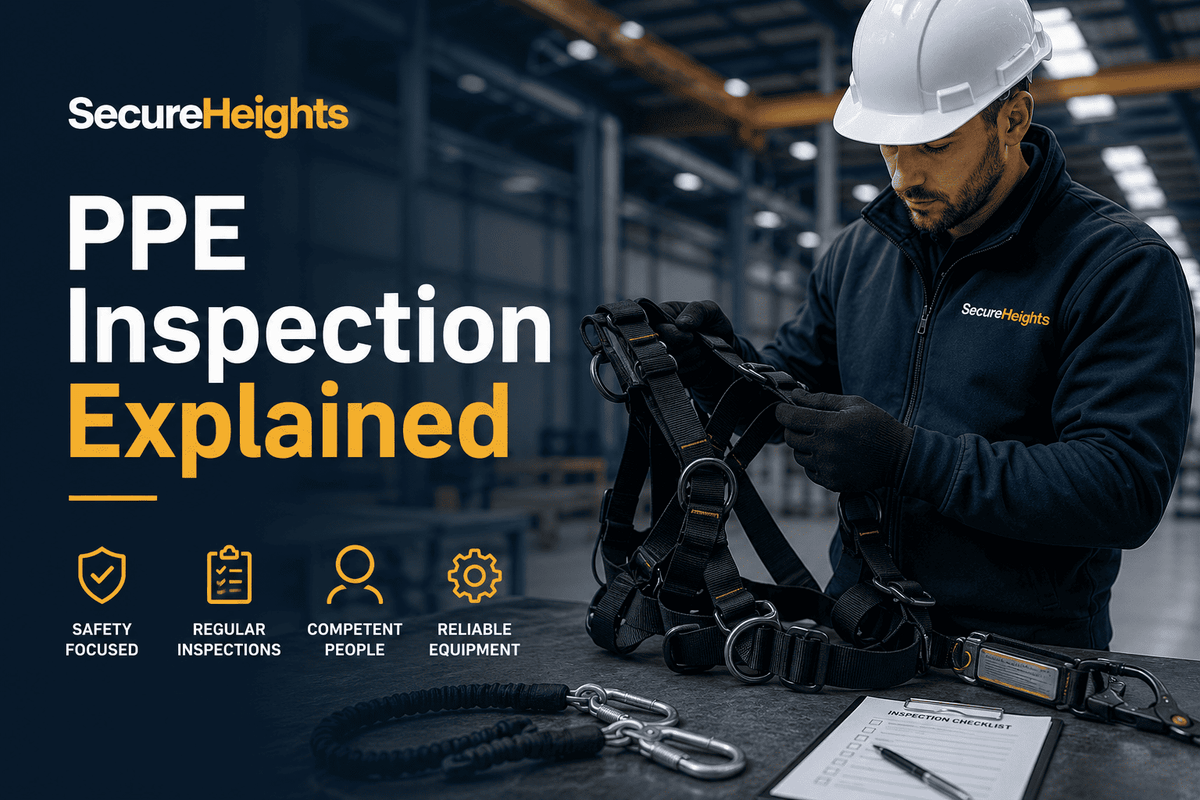
Key Points:
-
Fall protection PPE should be checked before use and included in a suitable formal inspection regime.
-
Inspection frequency should reflect HSE guidance, manufacturer instructions, equipment use and working conditions.
-
Harnesses, lanyards, connectors and SRLs require different inspection checks and rejection criteria.
-
Damaged or uncertain equipment should be quarantined and not returned to service until its safety is established.
Personal fall protection equipment may be the final means of protecting a worker if a fall occurs, so its condition must be checked carefully throughout its service life. Damage is not always immediately obvious. Cuts, abrasion, contamination, damaged stitching, corrosion or deterioration of mechanical components can affect performance even when equipment initially appears serviceable. A systematic PPE inspection helps identify these problems before the equipment is relied upon during work at height.
Fall protection equipment inspection covers more than harness inspection alone. Depending on the system, it can include harnesses, lanyards, energy absorbers, connectors, ropes and self-retracting fall arrest equipment. An appropriate inspection regime normally combines pre-use checks with more detailed inspections and, where conditions justify them, interim inspections. This guide focuses on personal fall protection equipment rather than permanent anchor systems, guardrails, fixed lifelines and other engineered height safety systems, which have their own inspection requirements.
Why Is Fall Protection Equipment Inspection Important?
Fall arrest PPE may be the final means of protecting a worker if a fall occurs, so deterioration must be identified before the equipment is relied upon. Cuts, abrasion, chemical attack, heat, UV exposure, contamination and previous loading can all affect performance, while some defects are difficult to recognise during a quick visual check.
Regular fall protection equipment inspection helps detect these problems early. HSE guidance notes that even relatively small cuts in webbing can significantly reduce strength, although the effect varies between products. PPE inspection should therefore follow defined criteria and manufacturer instructions rather than assuming that minor-looking fall protection equipment defects are acceptable.
PPE Inspection Requirements UK: HSE Guidance and BS EN 365
PPE inspection requirements UK are based on legislation, HSE guidance, relevant standards and manufacturer instructions. Regulation 12 of the Work at Height Regulations 2005 requires work equipment exposed to deterioration that could create dangerous situations to be inspected at suitable intervals and after exceptional circumstances that may affect safety. Regulation 5 also requires relevant work at height activities, including inspection, to be carried out by competent people.
The Personal Protective Equipment at Work Regulations 1992 require PPE to be properly maintained, stored and kept in efficient working order. Amendments that came into force in 2022 extended employers' PPE duties to certain workers who were not previously covered in the same way.
For fall protection PPE, important references include HSE INDG367, BS EN 365:2004 and BS 8437:2022. BS EN 365 covers areas including instructions for use, maintenance, periodic examination, repair, marking and packaging, while BS 8437 provides UK guidance on the selection, use and maintenance of personal fall protection systems.
Harness inspection requirements UK should not be reduced to a universal legal rule of one inspection every six months. HSE recommends detailed inspections at least every six months for the equipment covered by its guidance, with shorter intervals, such as three months, potentially appropriate for frequently used equipment in arduous conditions.
How Often Should Fall Arrest Equipment Be Inspected?
How often fall arrest equipment should be inspected depends on the equipment, manufacturer instructions, frequency of use, environment and risk of deterioration. A suitable PPE inspection frequency normally includes several levels of checking:
-
Pre-use checks are carried out by the user before use. A harness pre-use check should identify obvious cuts, abrasion, contamination, damaged stitching, deformation, malfunctioning connectors or signs of deployment. It does not replace a formal inspection.
-
Detailed inspections are more thorough, recorded examinations by a competent person. Equipment should be assessed against manufacturer instructions and rejection criteria. HSE recommends intervals of no more than six months for the equipment covered by INDG367, but this is not a universal statutory period.
-
Interim inspections may be needed where intensive use, abrasion, chemicals, paints, grit blasting, corrosion or other conditions could accelerate deterioration.
-
Exceptional-event inspections should be carried out where a fall, shock loading, severe contamination, heat exposure or another exceptional circumstance may have affected equipment integrity or jeopardised safety.
|
Inspection type |
When |
Typical responsibility |
Purpose |
|
Pre-use check |
Before use |
User |
Detect obvious defects |
|
Detailed inspection |
Planned intervals |
Competent person |
Formal condition assessment |
|
Interim inspection |
Where deterioration may accelerate |
Competent person |
Check between detailed inspections |
|
Exceptional-event inspection |
After potentially damaging events |
Competent person or manufacturer where required |
Determine whether equipment remains safe |

How to Inspect Fall Protection Equipment
Knowing how to inspect fall protection equipment starts with identifying the item, checking its traceability and referring to the manufacturer's instructions. The equipment should then be examined systematically, including accessible load-bearing parts and moving components where functional checks are permitted. A PPE inspection checklist can help ensure that the examination is carried out systematically, but any finding should be assessed against defined rejection criteria rather than appearance alone.
Key checks vary by equipment type:
-
Safety harness inspection: examine both sides of the webbing for cuts, fraying, abrasion, burns, glazing, chemical damage and contamination. Check load-bearing stitching, buckles, adjusters, D-rings and attachment points for wear, corrosion, cracks or deformation. Labels and identification should also remain legible where required.
-
Lanyard and energy absorber inspection: examine the full length of webbing or rope, including edges, stitching, terminations and connectors. Look for abrasion, cuts, contamination, heat or chemical damage. Check the energy absorber for signs of partial or complete deployment. A deployed absorber must not simply be reset and returned to use.
-
Carabiner and fall protection connector inspection: check the body for wear, cracks, corrosion and distortion. Gates and locking mechanisms must operate correctly and should not be obstructed by dirt, paint or corrosion. A connector that closes but does not lock as intended is not serviceable.
-
Self-retracting lifeline inspection: check the housing, lifeline, connectors, retraction and impact indicators where fitted. Functional locking checks should only be performed in accordance with the manufacturer procedure. Damage, irregular retraction or unusual operation may require withdrawal from service. An SRL should not be dismantled during routine inspection unless specifically authorised.
-
Rope and textile PPE inspection: inspect for cuts, abrasion, glazing, contamination, localised stiffness, changes in diameter, deformation and damaged terminations. Visual and tactile checks may both be necessary, depending on the rope construction.
If an item's condition cannot be confirmed against the applicable criteria, it should be quarantined rather than returned to use.
SecureHeights Comment: A generic inspection checklist should never take priority over the instructions supplied for the specific product. Fall protection equipment can differ significantly in construction, inspection points and rejection criteria, even where two products perform a similar function.
SecureHeights Fall Protection Equipment Overview
The inspection principles described above apply across a wide range of personal fall protection equipment, but the specific checks and rejection criteria depend on the product and its construction. SecureHeights supplies equipment for different work-at-height applications, including safety harnesses, lanyards and self-retracting lifelines. The following examples illustrate several types of fall protection PPE and the features relevant to their selection and ongoing inspection.
Petzl VOLT Fall Arrest and Work Positioning Harness European Version

(The Petzl VOLT Fall Arrest and Work Positioning Harness European Version designed for fall arrest, work positioning and restraint applications, depending on the attachment point and compatible equipment used. It features FAST LT PLUS and FAST LT automatic buckles for easier donning, DOUBLEBACK buckles for adjustment, wide semi-rigid waist and leg support, and multiple attachment points including sternal, dorsal, side, rear waistbelt and LADDER CLIMB ventral connections. The LADDER CLIMB point is designed for use with a fall-arrest trolley on vertical rail or cable systems and moves towards a sternal position in a fall. The harness is made from nylon, polyester, aluminium and steel, is available in three sizes from 2.1 to 2.23 kg, and is certified to CE EN 361, CE EN 358 and CE EN 813).
3M Protecta E200 Comfort Belt Style Fall Arrest Harness with Front, Rear & Side Attachment Points

(The 3M Protecta E200 Comfort Belt Style Fall Arrest Harness is designed for fall arrest and work positioning applications, with front, rear and side D-rings providing connection options for different working arrangements. It combines water and stain-resistant webbing with pass-through chest and leg connections, enhanced hip padding and a robust positioning belt that can accommodate tool bags. Auto-resetting lanyard keepers provide convenient storage for compatible connectors when not in use, while integrated impact indicators assist with identifying whether the harness may have been subjected to a fall event. Protected identification labels also support equipment traceability and inspection records, making this model particularly relevant where harness condition needs to be checked systematically throughout its service life).
3M DBI SALA ExoFit XE50 Positioning Safety Harness

(The 3M DBI-SALA ExoFit XE50 Positioning Safety Harness is designed for construction, positioning and climbing applications, combining 26 kN polyester webbing with alloy steel hardware and front, back and hip attachment points. Its back D-ring plate incorporates a personal SRL tunnel, while revolving torso adjusters help achieve an appropriate fit and auto-resetting, repositionable lanyard keepers provide convenient connector storage. The harness also incorporates low-profile suspension trauma relief straps and an integrated 3M Connected Safety ID using RFID technology, which can support equipment identification, inventory control and inspection record management. Available in three sizes with a stated weight capacity of 140 kg, the ExoFit XE50 is listed as complying with EN 358 and EN 361).
Skylotec CS 8 All-Round Fall Arrest Harness

(The Skylotec CS 8 All-Round Fall Arrest Harness is a multi-purpose harness intended for applications including rope access, scaffolding, rescue work and work on wind turbines. It incorporates side, dorsal, sternal and seat attachment points, allowing it to support different fall protection, positioning and suspension arrangements when used with compatible equipment. Padded hip and leg sections are intended to improve comfort during prolonged wear, while adjustment buckles allow the harness to be fitted to the user. The CS 8 is available in One Size and 3XL versions, with stated weights of approximately 1.96 kg and 2 kg respectively, and in black or orange. It is listed as conforming to EN 358:2018, EN 361:2002 and EN 813:2024. From an inspection perspective, particular attention should be paid to the webbing, load-bearing stitching, aluminium attachment points, adjustment hardware, padding and identification markings, with any signs of damage or deterioration assessed against Skylotec's inspection and rejection criteria).
P+P Safety Basic Fall Arrest Harness 90046MK4

(The P+P Safety Basic Fall Arrest Harness 90046MK4 is a single-point harness designed for fall arrest applications, with a rear dorsal D-ring providing the fall arrest attachment point. It uses polyester webbing with a water-repellent coating and incorporates heat-treated, zinc-plated carbon steel fittings. Adjustable shoulder straps with three-bar buckles allow the chest strap to be positioned over the sternum area, while three-bar slides and rectangular links are used at the leg and chest connections. The harness is available in Large and is listed as conforming to EN 361:2002. During inspection, attention should be given to the polyester webbing, load-bearing stitching, dorsal D-ring, buckles, slides and other metal fittings, including checks for cuts, abrasion, contamination, corrosion, deformation or other deterioration in accordance with the manufacturer's inspection and rejection criteria).
Whatever equipment is selected, it should be compatible with the intended fall protection system, working environment and application. Inspection, maintenance and withdrawal criteria should always follow the instructions provided for the specific product, rather than relying solely on general guidance or inspection procedures for similar equipment.
Fall Protection Equipment Defects: When Should PPE Be Removed from Service?
Damaged fall arrest equipment should be removed from service where inspection identifies defects that exceed manufacturer limits or create doubt about continued safe use.
Typical reasons include:
-
cuts, severe abrasion or damaged webbing or rope;
-
broken or damaged load-bearing stitching;
-
chemical or heat damage;
-
significant contamination;
-
cracks, deformation or significant corrosion;
-
malfunctioning connectors;
-
deployed energy absorbers;
-
activated impact indicators;
-
damaged SRL housings or lifelines;
-
unauthorised modification or repair;
-
missing identification where traceability is required.
There is no universal amount of visible damage that can automatically be considered acceptable. When deciding when to replace a safety harness or other PPE, manufacturer rejection criteria and equipment history should take priority over subjective judgement.
Suspect equipment should be quarantined so that it cannot accidentally be issued or used. It can then be assessed further, returned for authorised servicing where appropriate, or permanently withdrawn from service.
SecureHeights Comment: If there is uncertainty about the condition of fall protection PPE, the safest approach is to quarantine it until its suitability for continued use can be established. Replacing questionable equipment is preferable to relying on assumptions about whether visible damage is significant enough to affect performance.
Fall Protection Equipment Inspection After a Fall or Exceptional Event
Normal inspection intervals no longer apply where an event may have compromised equipment integrity. Regulation 12 of the Work at Height Regulations 2005 requires inspection following exceptional circumstances liable to jeopardise the safety of work equipment. This may include an arrested fall, suspected shock loading, severe chemical or heat exposure, contact with damaging edges, unusual contamination or damage during transport or storage.
Fall protection equipment after a fall should be withdrawn from normal use and dealt with according to the manufacturer's instructions. The same approach applies where significant loading or exposure is suspected but not confirmed. A routine visual check alone may not establish whether hidden damage has occurred. When required, further fall arrest equipment inspection, manufacturer assessment, servicing or replacement should take place before the item can be considered for further use.
Who Can Inspect Safety Harnesses and Fall Protection PPE?
Who can inspect safety harnesses depends partly on the type of inspection being performed. UK legislation focuses on competence rather than requiring every formal inspector to hold a qualification with a particular commercial title.
For pre-use checks and formal inspections, responsibilities differ:
-
User pre-use checks are normally carried out by the wearer. Users should know the main defects and rejection indicators relevant to their equipment, report abnormalities and avoid using PPE whose condition is uncertain.
-
Formal inspections require an appropriate competent person. Competence should reflect suitable knowledge, training and practical experience, familiarity with the equipment and its manufacturer instructions, and an understanding of relevant deterioration mechanisms and rejection criteria.
Competence for formal PPE inspection requires more than simply completing a PPE inspection course or following a generic harness inspection checklist. The inspector must be capable of recognising defects and understanding their significance for the particular equipment. Regulation 5 of the Work at Height Regulations establishes competence as the relevant requirement rather than prescribing one specific PFPE inspector certification.

PPE Inspection Records and Fall Protection Equipment Traceability
An effective PPE inspection procedure should include suitable record keeping so that individual equipment can be linked to its history and inspection status. A record should provide enough information to identify the item and understand what was found during the examination.
Depending on the equipment and inspection regime, fall protection inspection records may include:
-
unique equipment identification, manufacturer and model;
-
serial or batch number where provided;
-
inspection date and type;
-
inspector details;
-
findings and pass, fail or quarantine status;
-
remedial action where applicable;
-
next planned inspection;
-
photographs where they provide useful evidence.
Labels and markings are important to traceability. If an item cannot be positively identified, it may be impossible to connect it reliably with harness inspection records, determine relevant product information or confirm its inspection history. Missing or illegible identification should therefore be assessed against the manufacturer's requirements before continued use.
PPE Maintenance, Storage and Replacement After Inspection
Inspection establishes equipment condition, but it should not be confused with PPE maintenance, cleaning, servicing or repair. Each activity has a different purpose, and the manufacturer's instructions should determine what work is permitted and who may carry it out.
Fall protection equipment maintenance should include suitable cleaning and storage practices that do not introduce further deterioration. Aggressive chemicals, excessive heat and unsuitable washing or drying methods can damage textile components. Harnesses, lanyards and ropes should therefore be cleaned and stored using methods specified by their manufacturers.
Load-bearing stitching or other safety-critical components should not be modified or repaired without specific authorisation. Where servicing or repair is permitted, it may need to be completed by the manufacturer or another appropriately competent or authorised party. Mechanical fall arresters may also require planned maintenance, testing, examination or overhaul in addition to routine inspection. Fall protection PPE replacement should follow applicable rejection criteria, service requirements and manufacturer instructions rather than attempting to extend the life of unsuitable equipment.
Fall Protection Equipment Inspection vs Engineered System Inspection
Fall protection equipment inspection should not be confused with inspection of the complete height safety installation. This article focuses on personal equipment such as harnesses, lanyards, connectors and fall arresters. Permanent anchor points, horizontal or vertical lifelines, guardrails, roof walkways, fixed ladders, davits and other engineered access or fall protection systems can have separate inspection requirements.
A harness or lanyard inspection does not confirm the structural condition, installation or inspection status of the system to which it is connected. Equally, an anchor point inspection or fall protection system inspection does not establish that the user's PPE is serviceable.
This distinction is reflected in HSE INDG367, whose inspection guidance for relevant webbing and rope fall arrest equipment does not cover anchor points. Anchor devices form a separate equipment category, with applicable standards including BS EN 795:2012 depending on the type and application.
Common PPE Inspection Mistakes to Avoid
A PPE inspection can provide false confidence if it is performed inconsistently or without reference to the equipment being examined. An inspection checklist for PPE can help structure the process, but it cannot replace manufacturer-specific criteria or competent judgement.
Common mistakes include:
-
relying on a quick visual glance or examining only one face of webbing;
-
treating six months as a universal inspection interval for every item;
-
confusing a pre-use check with a formal detailed inspection;
-
ignoring manufacturer instructions or harsh environmental conditions;
-
returning equipment to use after a fall without appropriate assessment;
-
overlooking partial energy absorber deployment;
-
checking connector appearance without testing permitted functions;
-
dismantling SRLs or attempting unauthorised repairs;
-
failing to quarantine defective or questionable equipment;
-
maintaining incomplete records or losing equipment traceability;
-
assuming a safety harness inspection checklist also covers anchors or engineered systems.
A consistent inspection regime should instead reflect the equipment, its use, working environment and manufacturer requirements, with suspect items controlled until their suitability for further use has been established.
Conclusion
Effective PPE inspection depends on more than following a fixed schedule. Pre-use checks, detailed and interim inspections, accurate records, correct maintenance and clear quarantine procedures all help ensure that personal fall protection equipment remains suitable for use. Inspection regimes should reflect the equipment, working conditions, manufacturer instructions and applicable UK requirements, with any item of uncertain condition withdrawn until its safety can be established.
SecureHeights supplies a wide range of fall protection and PPE equipment, including safety harnesses, lanyards, self-retracting lifelines, anchors and equipment for access and rescue applications. When selecting replacement PPE or developing a compatible fall protection solution, the SecureHeights team can provide product support to help identify equipment suited to the intended application and working environment.

