Key Points:
-
Anchor points form the foundation of every personal fall protection system and must always be selected for the specific structure and task.
-
Different anchor types are designed for different applications, including temporary work, permanent installations, roof access and confined spaces.
-
Proper installation, regular inspection and compliance with UK standards are essential for maintaining a safe and reliable anchorage system.
-
SecureHeights supplies certified anchor devices, anchorage systems and expert support to help organisations implement compliant work at height solutions.
Anchor points form the foundation of every personal fall protection system used for working at height. Whether the objective is to prevent a fall through a restraint system or safely arrest a fall after it occurs, the anchor provides the secure connection between the worker and the supporting structure. Even the highest quality safety harness, lanyard or self retracting lifeline cannot perform as intended if it is attached to an unsuitable or incorrectly installed anchor point.
Understanding the different types of anchor points, their intended applications and the standards that govern their use is essential for selecting appropriate fall protection equipment. This guide explains how anchor points work, the differences between anchor points, anchor devices and complete anchorage systems, where they are commonly used, and the key UK regulations, inspection requirements and selection factors that help ensure safe and compliant working at height.
What Are Anchor Points?
An anchor point is a secure attachment location capable of supporting the loads generated by a personal fall protection system. It connects a worker to equipment such as a lanyard, self retracting lifeline or rope system, transferring forces safely into the supporting structure if a fall occurs. Depending on the application, an anchor point may be permanently installed as part of a building or temporarily fitted for a specific task before being removed once the work has been completed.
Within a Personal Fall Arrest System (PFAS), the anchor point is one of the primary system components alongside the full body harness and connecting device. These elements are designed to function together as a complete system rather than as individual pieces of equipment. The performance of the entire fall protection system depends on the suitability, strength and positioning of the anchor point. Even correctly selected PPE cannot provide effective protection if it is connected to an unsuitable anchorage.
Anchor points may be attached directly to structural steel, reinforced concrete, engineered roof systems or other load bearing structures that have been assessed for the intended application. The type of anchor selected depends on factors such as the working environment, duration of use, number of users and whether the system is intended for fall restraint, fall arrest or rope access.
What Are Anchor Points Used For?
Anchor points are used across a wide range of working at height activities where workers require protection from falling or need to remain safely connected while carrying out specialist tasks. Their exact purpose depends on the type of personal protective system being used and the hazards identified during the risk assessment.
In fall restraint systems, the anchor point prevents the user from reaching an exposed edge by limiting movement before a fall can occur. In fall arrest systems, the anchor serves as the structural connection that arrests the fall after it has started while working with energy absorbing equipment designed to reduce arrest forces.
Anchor points are also used for work positioning systems, allowing workers to maintain a stable hands free position while remaining securely supported. Industries such as telecommunications, utilities and structural maintenance frequently use work positioning equipment when carrying out prolonged tasks on poles, towers or similar structures.
For rope access operations, anchor points form the basis of both the working line and the independent safety line. These systems require carefully selected anchor arrangements that can support dynamic and static loads while providing redundancy should one part of the system fail. Because rope access often involves complex rescue procedures, anchor selection and system design are subject to particularly rigorous planning and inspection requirements.
Anchor Point vs Anchor Device vs Anchorage System
The terms anchor point, anchor device and anchorage system are often used interchangeably, but they describe different parts of a fall protection system. Understanding these differences helps ensure equipment is selected correctly, installed appropriately and used in accordance with applicable standards.
Anchor Point
An anchor point is the specific location where a worker's fall protection equipment is attached. It may consist of a permanently installed eye bolt, roof anchor, structural beam connection or another approved fixing point capable of supporting the required loads. The anchor point itself is the physical connection between the worker and the supporting structure.
Anchor Device
An anchor device is the piece of equipment that creates or provides the anchor point. Examples include temporary webbing anchor slings, beam clamps, portable deadweight anchors, roof anchor posts and removable concrete anchors. Some anchor devices are designed for repeated installation and removal, while others become permanent parts of a building or engineered safety system.
Anchorage System
An anchorage system is the complete arrangement that provides safe attachment for one or more users. It may include multiple anchor devices, supporting structural elements, horizontal lifeline systems, rigid rail systems, intermediate brackets and connection hardware. The anchorage system is designed as an integrated solution that distributes loads safely while allowing workers to move within a defined working area.
Why Understanding the Difference Matters
Confusing these terms can result in incorrect equipment selection or unsafe installation. For example, replacing a certified anchor device with an unsuitable fixing point or assuming that any structural member automatically qualifies as an anchor point may expose workers to unacceptable risks. During planning, inspection and certification, each component must be assessed individually while also considering how it functions as part of the complete fall protection system.
|
Term |
Description |
Typical Example |
|
Anchor Point |
The location where the worker connects their fall protection equipment |
Fixed eye bolt, roof anchor eye, structural attachment point |
|
Anchor Device |
Equipment that creates or provides the attachment point |
Beam clamp, webbing sling, temporary roof anchor, deadweight anchor |
|
Anchorage System |
The complete assembly supporting one or more users |
Horizontal lifeline system, rigid rail system, engineered roof safety system |

How Anchor Points Work in a Fall Protection System
When a fall occurs, the worker's weight and the dynamic forces generated during the arrest are transferred through the connecting equipment into the anchor point and finally into the supporting structure. The anchor must be capable of withstanding these forces without excessive movement or structural failure. At the same time, compatible energy absorbing equipment helps reduce the loads transmitted to both the worker and the anchorage system.
The effectiveness of this process depends on every component working together. The harness distributes arrest forces across the body, the connecting device manages energy where required, and the anchor safely transfers those forces into the building or structure supporting the system.
Why Anchor Position Matters
The location of the anchor point has a significant influence on overall system performance. Wherever reasonably practicable, the anchor should be positioned above the worker to minimise free fall distance and reduce the likelihood of pendulum movement. Poorly positioned anchors may increase arrest forces, require greater clearance below the user and expose workers to additional hazards during a fall.
Anchor positioning should also take account of the worker's expected movement throughout the task. Systems that allow unrestricted travel without considering changing angles may increase the risk of swing falls or place excessive loading on certain components.
Free Fall Distance and Swing Falls
One of the primary objectives when selecting an anchor location is to minimise free fall distance. A longer free fall generally results in greater arrest forces and requires increased clearance below the worker to prevent contact with lower levels or surrounding obstacles.
Anchors positioned significantly to one side of the working area may also create a swing fall hazard. During a fall, the worker can swing towards the anchor in an arc similar to a pendulum, increasing the risk of striking nearby structures. Careful planning of anchor locations and worker travel paths helps reduce this risk.
Compatibility with Other PPE
An anchor point must always be compatible with the rest of the personal fall protection system. Connectors should fit correctly without side loading, cross loading or placing excessive stress on gates or locking mechanisms. Anchor devices should also be suitable for the connecting equipment being used, whether that is an energy absorbing lanyard, self retracting lifeline, rope grab or work positioning lanyard.
Compatibility extends beyond physical connection. Every component should be selected to function as part of a complete system with appropriate load ratings, certifications and intended applications. Mixing incompatible equipment or using components outside their specified purpose may reduce system performance and compromise worker safety.
Types of Anchor Points for Working at Height
Anchor points are available in several configurations to suit different structures, working environments and methods of access. No single anchor type is suitable for every application. The correct choice depends on how the work will be carried out, how far the worker needs to move, whether the system is temporary or permanent, and the characteristics of the supporting structure. BS EN 795 classifies anchor devices into several categories, each designed for specific applications.
Type A Fixed Anchors
Type A anchors are permanently attached to a building or structure and remain in place after installation. Common examples include roof anchor posts, eye bolts, anchor plates and fixed attachment points installed on structural steel or reinforced concrete.
These anchors are typically used where regular access is required for maintenance, inspection or cleaning. They provide a dedicated connection point that is always available without requiring additional installation before work begins.
Because they become part of the structure, fixed anchors should be installed only on suitable load-bearing elements. Their location should allow workers to connect before entering the hazardous area while providing effective protection throughout the task.
Type B Temporary Anchors
Type B anchors are portable devices that can be installed and removed as required. They are commonly used during construction, short-term maintenance and projects where permanent anchors are not available.
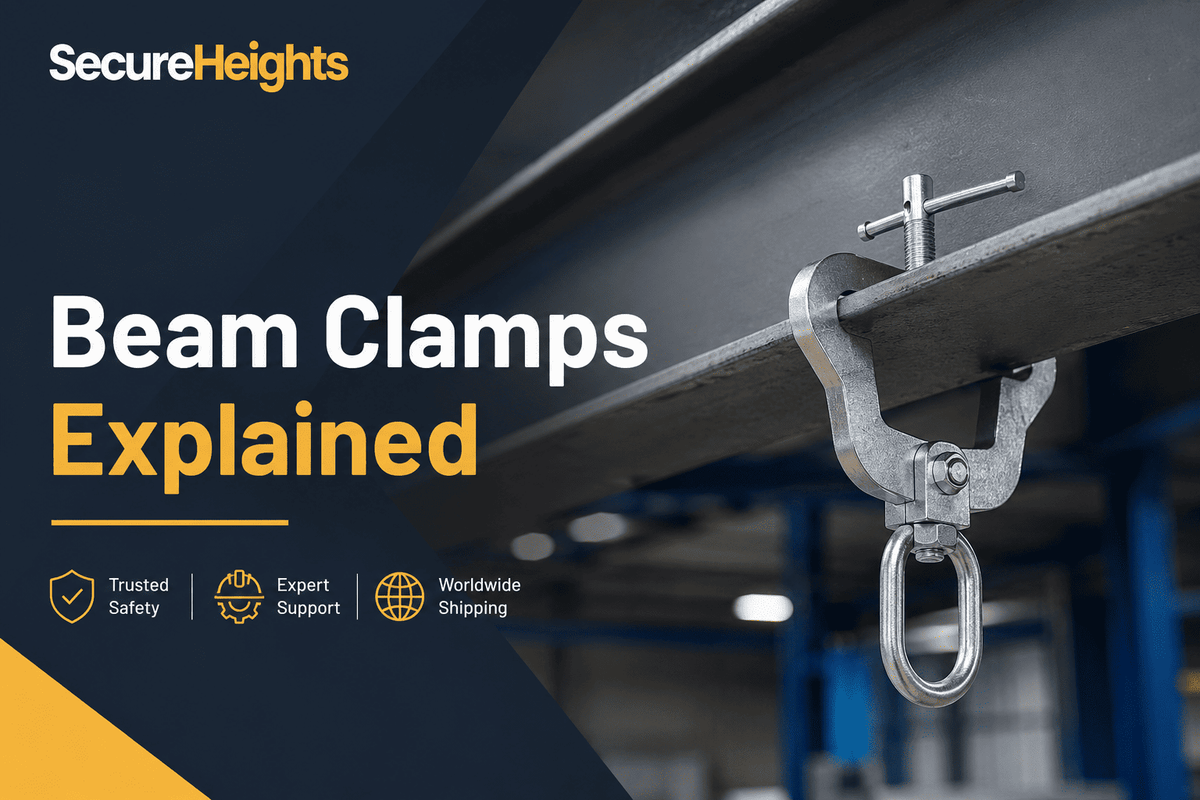
Examples include beam clamps, webbing anchor slings, removable concrete anchors and temporary steel attachment devices. Their main advantage is flexibility, allowing the anchorage to be positioned close to the work area.
Although removable, these devices still require a suitable supporting structure. Temporary anchors should never be attached to pipes, handrails or other components that have not been designed or approved for fall protection.
Type C Horizontal Flexible Lifelines
Type C systems consist of a flexible horizontal cable or rope supported by multiple anchor points. Workers connect using a compatible travelling device, allowing continuous movement across large working areas without disconnecting.
These systems are widely used on roofs, bridges, industrial plants and loading facilities where maintenance personnel need to travel significant distances while remaining protected.
As the lifeline will deflect during a fall, the system must be designed with sufficient clearance below the worker. The length of the span, cable tension, end anchors and number of users all influence overall performance.
Type D Rigid Rail Systems
Type D systems use a rigid rail instead of a flexible cable. A travelling attachment moves along the rail while remaining permanently connected to the worker.
Rigid rail systems are commonly installed in manufacturing facilities, aircraft maintenance hangars, overhead crane systems and permanent access routes. Because the rail produces very little deflection during fall arrest, these systems are often suitable where available clearance is limited.
They also provide predictable movement and reduce swing fall hazards compared with some flexible lifeline installations.
Type E Deadweight Anchors
Type E anchors provide protection without being mechanically fixed to the structure. Instead, they rely on carefully designed counterweights to resist movement.
They are primarily used on flat roofs where penetrating the waterproof membrane is undesirable. This allows temporary maintenance work to be completed without permanently altering the roof.
Deadweight systems are only suitable for approved roof types and gradients. Roof construction, surface condition and environmental factors should always be assessed before use.
Recommended Fall Protection Anchors
Selecting the right anchor device is just as important as understanding how anchor points work. The products below represent a selection of anchorage solutions available from SecureHeights, covering temporary and permanent installations, structural steel, concrete, roof access and specialist applications. Choosing equipment that matches the structure, working environment and fall protection system helps ensure both compliance and user safety.
3M Protecta Galvanised Cable Sling 1m-2m

(The 3M Protecta Galvanised Cable Sling is a lightweight portable anchorage solution designed to create a secure connection for fall protection equipment, particularly where suitable overhead anchorage locations are difficult to reach directly. Manufactured from galvanised steel for corrosion resistance, the sling features thimble ends for reliable connection and a protective PVC sleeve that helps reduce wear compared with a conventional unprotected sling. Its portable design makes it particularly practical for temporary anchorage arrangements in construction environments where workers may need to establish and relocate attachment points as work progresses. Available in 1 m and 2 m lengths, the Protecta Cable Sling provides a simple and durable option for creating temporary anchor connections around suitable structural elements).
Skylotec BEAMTAC 2.0 9cm-36cm Fixed Beam Anchor AP-075

(The Skylotec BEAMTAC 2.0 Fixed Beam Anchor AP-075 is a mobile anchoring device designed to create a secure attachment point on suitable steel beams with flange widths from 90 to 360 mm. Developed for industrial and steel construction as well as rope access applications, it features easily adjustable clamping jaws for quick installation and a multi-level safety system designed to prevent unwanted movement or slipping during use. Its aluminium construction provides a robust anchorage solution while keeping the overall weight to 2.32 kg, making it practical for applications where anchor locations may need to change as work progresses. Suitable for up to two users, the BEAMTAC 2.0 complies with EN 795:2012 Type B and CEN/TS 16415:2013, as well as ANSI/ASSP Z359.18-2017, providing a versatile temporary anchorage option for industrial environments with suitable structural steel beams).
Fallprotec Twinfix Stainless Steel 13mm Anchor Point LDV057

(The Fallprotec Twinfix Stainless Steel 13mm Anchor Point LDV057 is a permanent anchor point designed for fall arrest, fall restraint and rope access applications where long-term structural anchorage is required. Manufactured from AISI 316 stainless steel, it is suitable for installation on floors, walls or ceilings using two M12 fixings and offers excellent corrosion resistance for demanding environments. With a breaking strength exceeding 30 kN and certification for up to two users, the Twinfix is commonly used in rope access systems where paired anchor points provide separate connections for the working and safety lines. Certified to EN 795:2012 Type A and CEN/TS 16415:2013, it provides a robust and reliable anchorage solution for maintenance, inspection and industrial access work).
3M DBI SALA Mobi-Lok Aviation Vacuum Anchor with Bottle Attachment and Carrying Case 2200126

(The 3M DBI-SALA Mobi-Lok Aviation Vacuum Anchor 2200126 is a specialist fall protection anchorage system designed to create a secure tie-off point on smooth, non-porous surfaces where conventional fixed or structural anchors may not be practical. Developed particularly for aviation applications, it uses vacuum technology to establish an anchorage point on surfaces such as aircraft, tanks and railway carriages, with a visual green-light indication confirming when the system is ready for use. The self-contained design incorporates an attachment for an onboard compressed gas bottle, reducing the need for separate pumps and vacuum hoses, while the system can also operate from a larger external gas bottle or shop air where appropriate. Unlike more restrictive restraint-only solutions, the Mobi-Lok is rated for fall arrest and provides greater flexibility in positioning around suitable work surfaces. Supplied with a carrying case and weighing 27.44 kg, it offers a highly specialised portable anchorage solution for maintenance and other work at height where traditional anchor devices cannot easily be installed).
Petzl COEUR BOLT STAINLESS Steel Anchor for Exterior Environments (Pack of 20)

(The Petzl COEUR BOLT STAINLESS is a permanent stainless steel anchor designed for reliable installation in typical exterior environments. Manufactured from corrosion-resistant 316L stainless steel, each assembly combines a COEUR STAINLESS hanger, bolt and nut, with a textured anti-rotation back that helps prevent the hanger from turning during installation or when subjected to significant lateral loading. The wide, ergonomic connection hole makes carabiner clipping easier and can accommodate two carabiners simultaneously, while its rounded edges and hanger thickness help limit connector wear during repeated use. Available with either 10 mm or 12 mm bolts, the anchor provides a shear resistance of 25 kN in 50 MPa concrete, with pull-out strength of 15 kN for the 10 mm version and 18 kN for the 12 mm version. Certified to EN 959 and supplied in packs of 20, the COEUR BOLT STAINLESS provides a durable anchorage solution for permanent installations in standard outdoor conditions).
SecureHeights supplies a comprehensive range of fall protection anchors from leading manufacturers including 3M DBI SALA, 3M Protecta, Petzl, Skylotec, CAMP Safety, Climbing Technology, Fallprotec and Kaya Safety. Whether you require a simple anchorage strap for temporary work or a permanent structural anchor for long-term access, our team can help you select equipment that is suitable for your application and compliant with relevant UK and European standards.
Where Are Anchor Points Used?
Anchor points are used wherever workers may be exposed to a fall hazard. Although the equipment varies between industries, the objective remains the same: providing a secure connection between the worker and the supporting structure.
Common applications include:
-
Construction – structural steel erection, concrete frames, bridge construction and façade installation.
-
Roofing – inspections, repairs, solar panel installation, gutter maintenance and access to rooftop plant.
-
Industrial maintenance – servicing machinery, pipework, conveyors and elevated process equipment.
-
Telecoms and utilities – communication towers, electrical infrastructure and wind turbines.
-
Manufacturing and warehouses – maintenance of overhead cranes, production lines, storage systems and lighting.
-
Confined spaces – entry into tanks, shafts and chambers using tripods, davit systems and rescue equipment.
Different industries often require different anchor configurations, but every installation should be selected according to the task, supporting structure and findings of the risk assessment.
Anchor Point Requirements Before Installation
Installing an anchor point begins with assessing the structure rather than selecting the equipment. Even a certified anchor device cannot provide adequate protection if it is attached to an unsuitable location. Before installation, several key factors should always be considered.
-
Structural strength. The supporting structure must safely withstand the loads generated during normal use and, where applicable, during fall arrest. Structural integrity should always be verified rather than assumed.
-
Anchor location. The anchor should be positioned to provide safe access while allowing the worker to remain connected throughout the task. Good positioning improves accessibility and reduces unnecessary exposure to fall hazards.
-
Number of users. Some anchors are designed for a single user, while others can support multiple users simultaneously. The certified capacity should never be exceeded.
-
Clearance requirements. Sufficient space must be available below the worker to accommodate the complete fall arrest distance, including equipment extension and system deflection where applicable.
-
Rescue considerations. The anchor location should support an effective rescue plan. Recovery procedures, access routes and suitable rescue equipment should all be planned before work starts.
-
Environmental conditions. Corrosion, chemicals, moisture, high temperatures, ultraviolet exposure and other environmental factors may influence both anchor selection and long-term performance.
Selecting the correct anchor point therefore involves more than choosing equipment with an adequate strength rating. The supporting structure, accessibility, positioning and compatibility with the complete fall protection system all contribute to ensuring the anchor performs safely throughout its service life.
SecureHeights Expert Comment: At SecureHeights, we regularly find that the most common problems arise before work even begins. Confirming the suitability of the supporting structure and selecting an anchor that matches the application are often far more important than simply choosing a certified product. Taking the time to assess these factors helps reduce installation issues and improves overall safety.
Single User and Multi User Anchor Systems
Anchor systems are not all designed for the same level of use. Some provide protection for a single worker, while others allow several people to work simultaneously from the same anchorage. Selecting the correct system is important because the number of connected users directly influences the loads that may be generated during a fall.
Single User Anchors
Single user anchors are certified for one worker at a time and are commonly installed on roofs, ladders, access platforms and maintenance areas. They provide a practical solution where only occasional access is required or where work is carried out individually.
Multi User Anchors
Multi user anchors are intended to support two or more users simultaneously. They are frequently incorporated into horizontal lifeline systems, rigid rail systems and permanent access installations on large buildings or industrial facilities. Because several workers may rely on the same anchorage, these systems require additional engineering consideration and appropriate certification.
When Multi User Systems Are Required
Multi user systems are particularly beneficial where teams work together in the same location, such as construction sites, industrial shutdowns, bridge maintenance or large roofing projects. They improve productivity by allowing multiple workers to remain connected without installing separate anchor points for each individual. However, the certified user capacity should never be exceeded, and all connected equipment must be compatible with the anchor system.

Anchor Point Standards and UK Regulations
Anchor points should always be selected, installed and managed in accordance with recognised legislation and technical standards. Some documents establish legal duties, while others define how anchor devices should be tested, installed or maintained. Together they provide a framework for designing safe and compliant fall protection systems.
The principal legislation, standards and guidance include:
-
Work at Height Regulations 2005 – the main UK legislation covering work at height. It requires employers to properly plan work, select suitable equipment, reduce fall risks wherever possible and ensure equipment remains safe throughout its use.
-
BS EN 795 – the primary product standard for anchor devices. It classifies different types of anchors and specifies the performance and testing requirements manufacturers must meet.
-
BS 7883 – provides guidance on the design, installation, inspection and maintenance of permanent anchor systems. It helps ensure that anchor installations remain suitable for the structure and intended application.
-
BS EN 353-1 and BS EN 353-2 – apply to guided type fall arrest systems using rigid or flexible anchor lines. These standards are commonly associated with vertical ladder safety systems and permanent climbing routes.
-
BS 8610 – offers guidance on selecting compatible personal fall protection equipment, helping ensure that anchors, harnesses, lanyards and connecting devices operate safely as a complete system.
-
PD CEN/TS 16415 – supplements BS EN 795 by introducing additional requirements for anchor devices designed to protect multiple users at the same time.
-
EN 365 – establishes general requirements for inspection, maintenance, marking and user information for personal fall protection equipment, supporting safe management throughout its service life.
Although each document covers a different aspect of fall protection, they are often applied together when specifying, installing and maintaining anchor systems. Compliance should therefore be considered as part of the entire fall protection system rather than focusing on the anchor device alone.
Anchor Point Inspection and Maintenance
Anchor points should be inspected throughout their service life to ensure they remain safe for continued use. Environmental exposure, corrosion, accidental damage and repeated loading may all affect their performance over time. A planned inspection programme helps identify potential issues before they become a safety risk.
Routine inspection typically includes:
-
Pre-use checks carried out by the user before every task to identify visible damage, corrosion, loose fixings, excessive wear or missing identification markings.
-
Periodic inspections completed by a competent person at intervals specified by the manufacturer or determined by the working environment and frequency of use.
-
Inspection following a fall arrest event, as any anchor involved in stopping a fall should be removed from service until it has been formally assessed and declared suitable for continued use.
-
Maintenance and record keeping, including cleaning where appropriate, replacing damaged components using approved parts and maintaining inspection records for future reference.
Inspection frequency should reflect the conditions in which the anchor operates. Systems exposed to coastal environments, chemicals, heavy industrial use or severe weather may require more frequent assessment than anchors installed in protected locations.
Maintaining accurate inspection records also provides evidence that the system has been managed responsibly throughout its service life. Together with regular maintenance and timely replacement of damaged components, documented inspections help ensure anchor points continue to provide reliable protection whenever work at height is carried out.
Common Mistakes When Selecting and Using Anchor Points
Even high quality anchor equipment cannot provide adequate protection if it is selected, installed or used incorrectly. Many incidents involving work at height are linked not to equipment failure, but to poor planning, unsuitable anchorage or incorrect system design. Understanding the most common mistakes helps reduce risk and supports safer working practices.
Common mistakes include:
-
attaching anchor devices to structures that are not capable of supporting the required loads
-
selecting an anchor type that is unsuitable for the task or working environment
-
failing to allow sufficient fall clearance beneath the user
-
positioning anchors in locations that increase the risk of swing falls
-
connecting incompatible components within the fall protection system
-
exceeding the certified capacity of single user or multi user anchors
-
carrying out work without a suitable rescue plan
-
neglecting routine inspections and maintenance of anchor systems
-
assuming that all roofs are suitable for anchor installation without structural assessment
-
installing anchor devices incorrectly or failing to follow the manufacturer's instructions
Most of these issues can be avoided during the planning stage. A suitable risk assessment, structural evaluation and careful selection of compatible equipment are just as important as the quality of the anchor device itself. Workers should also receive appropriate training so they understand where anchor points may be installed, how they should be used and what limitations apply to the system.
Anchor points should never be viewed as standalone items of equipment. Their performance depends on the strength of the supporting structure, the design of the complete fall protection system and the competence of those responsible for installation, inspection and use. When these elements work together, anchor systems provide reliable protection and help create a safer working environment for anyone carrying out work at height.
SecureHeights Expert Comment: Many of the issues we encounter are not caused by equipment failure but by incorrect planning or incompatible system components. Choosing suitable anchor devices, ensuring compatibility across the entire fall protection system and maintaining regular inspections significantly reduces the likelihood of incidents and helps keep equipment compliant throughout its service life.
Conclusion
Anchor points form the foundation of every personal fall protection system. Selecting the correct anchor, ensuring it is compatible with the rest of the equipment and maintaining it throughout its service life are all essential steps in protecting workers at height. A suitable anchor is not simply one with an adequate strength rating. It must also be appropriate for the structure, the working environment, the number of users and the type of work being performed. Combined with competent installation, regular inspection and a well planned rescue strategy, correctly specified anchor systems help create safer and more reliable working at height solutions.
At SecureHeights, we supply a comprehensive range of certified anchor devices, anchorage systems and height safety equipment from leading manufacturers, together with safety harnesses, self retracting lifelines, davit systems, confined space equipment and engineered access solutions. Whether you require equipment for roof work, industrial maintenance, confined space entry or permanent access installations, our team can help you select products that are suitable for your application and compliant with current UK standards. With expert technical support, premium brands, fast UK delivery and worldwide shipping, SecureHeights provides reliable fall protection solutions for organisations working safely at height.